

I love football, and have been a fan for a very long time, but I know many of you are new to the game! Maybe your child is playing youth football, or your significant other is a huge fan of the game, and you just want to learn a little bit about the game, so you can enjoy watching! I did a basic overview of how the game is played in the Beginner’s guide to understanding American Football a few weeks ago, so check that out too!

If you want to know what is going on during a game of football, it really helps to get familiar with key terms and what they mean, so that is what I’m going to focus on today. While there are probably hundreds of terms tossed around during any given game, this list fills you in on the basic football terms you need to know (in alphabetical order, to help you find what you need FAST):
Backfield: The area of the field behind the line of scrimmage. It can also refer to members of the offense who begin play behind the line, including the quarterback, running back and fullback.
Down: A period that starts when the ball is put into play and ends when the ball is ruled dead (the play is completed). The offense gets four downs to advance the ball 10 yards. If it fails to do so, it must surrender the ball to the opponent, usually by punting on the fourth down. First down is the first of the plays; fourth is the last down.
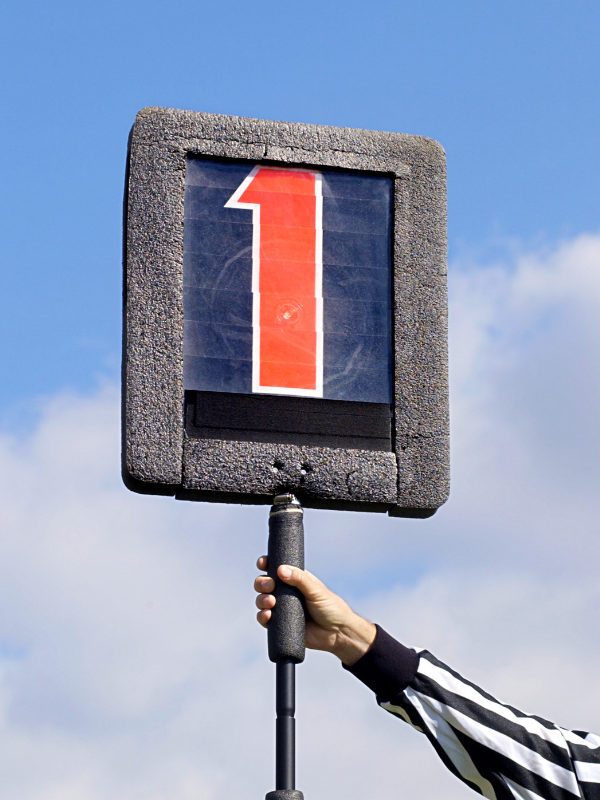
Drive: The series of plays when the offense has the football, until it punts or scores and the other team takes possession of the ball.
End zone: A 10-yard-long area at each end of the field, which is the scoring area of the field. It is bordered on all sides by a white line, with orange, square pylons at each of the four corners.
Extra point: A kick, worth one point, that’s attempted after a touchdown (it’s also known as the point after touchdown, or PAT). The ball is kicked from inside the 10-yard line after being snapped to the holder. It must move between the uprights and above the crossbar of the goalpost to be counted as good.
Fair catch: When the player returning a punt waves his extended arm from side to side over his head to signal a fair catch, The player can’t run with the ball, and those attempting to tackle him can’t touch him.
Field goal: A kick, worth three points, that can be attempted from anywhere on the field, but is usually attempted within 40 yards of the goalpost. Like an extra point, a kick must sail above the crossbar and between the uprights of the goalpost to be ruled good.
Fumble: Losing possession of the ball while running with it or being tackled. Members of the offense and defense can recover a fumble. If the defense recovers the fumble, the fumble is called a turnover.
Handoff: Giving the ball to another player. Handoffs usually occur between the quarterback and a running back.
Hash marks: The lines on the center of the field to mark each yard line on the field. Before every play, the ball is spotted between the hash marks or on the hash marks, depending on where the ball carrier was tackled on the preceding play.

Huddle: When the 11 players on the field come together to discuss strategy between plays. On offense, the quarterback relays the plays in the huddle.
Incompletion: A forward pass that falls to the ground because no receiver could catch it, or a pass that a receiver dropped or caught out of bounds.
Interception: A pass that’s caught by a defensive player, ending the offense’s possession of the ball. It is also known as a pick. A “pick 6” occurs when a defensive player catches the ball and runs into the end zone for a touchdown (gaining 6 points).
Kickoff: A free kick that puts the ball into play, where the receiving team can’t make an attempt to block it. A kickoff is used at the start of the first and third quarters and after every touchdown and successful field goal.
Line of scrimmage: An imaginary line that extends from where the football is placed on the field at the end of play, to both sides of the field. Neither the offense nor the defense can cross the line until the football is put in play again.
National Football League (NFL) has 32 teams split into two conferences (National and American) and four divisions each (North, West, East and South).
Offensive line: The human wall of five men who block for and protect the quarterback and ball carriers. Every line has a center (who snaps the ball), two guards, and two tackles.
Pass: A player, usually the quarterback, attempts to get the ball to another player by throwing the ball through the air between them.
Punt: A kick made when a player drops the ball and kicks it while it falls toward his foot. A punt is usually made on a fourth down when the offense must surrender possession of the ball to the defense because it couldn’t advance 10 yards.
Red zone: The unofficial area from the 20-yard line to the defensive team’s goal line. A team has a high “red zone percentage” when the number of touchdowns scored from within the red zone is a high compared to the number of drives in which the team enters the red zone.
Return: Receiving a kick or punt and running toward the opponent’s goal line, with the intent of scoring or gaining significant yardage.
Rushing: To advance the ball by running, not passing. A running back is sometimes called a rusher.
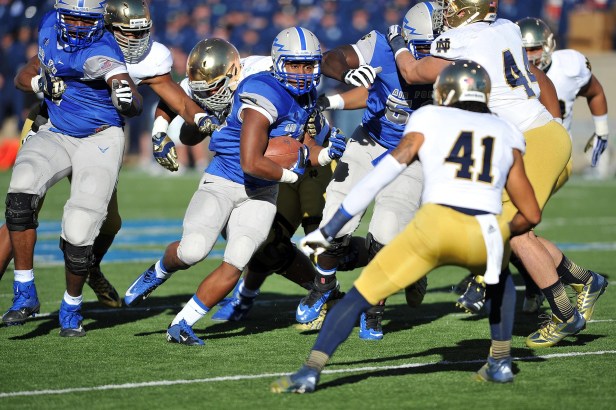
Sack: When a defensive player tackles the quarterback behind the line of scrimmage for a loss of yardage.
Safety: A score, worth two points, that the defense earns by tackling an offensive player in possession of the ball in his own end zone.
Secondary: The four defensive players who defend against the pass and line up behind the linebackers and wide on the corners of the field opposite the receivers.
Snap: The ball is hiked, or tossed between the legs of the center to the quarterback. The ball is also hiked to the holder on a kick attempt, or to the punter. When the snap occurs, the ball is officially in play and action begins.
Special teams: The 22 players who are on the field during kicks and punts. These units have special players who handle kickoffs, punts, free kicks and field goal attempts.
Touchdown: A score, worth six points, occurs when a player in possession of the ball crosses the plane of the opponent’s goal line, or when a player catches the ball while in the opponent’s end zone.

I hope you find this list of terms and definitions helpful!
See you soon,
Carrie


 Team Colors By Carrie